
Large language models have made it possible to talk to software in a remarkably natural way. But a good conversation is not the same thing as a dependable personal system.
A model can explain how to coordinate a family schedule, adjust a smart home, prepare a report, or track a changing event. The harder problem is giving it enough durable context, authority, tools, and time awareness to carry that responsibility beyond a single chat.
That is the problem I have been exploring through Hopper, the intelligence layer in my broader MauriceOS environment. Hopper is not intended to be another general-purpose chatbot. It is an experiment in a different architectural pattern: a persistent layer that sits between human intent and the growing collection of models, applications, services, devices, and data involved in daily life.
The practical value is not that the AI can answer more questions. It is that the system can preserve how a household works, select the right capability, act through the right surface, and remain responsible after the original request has ended.
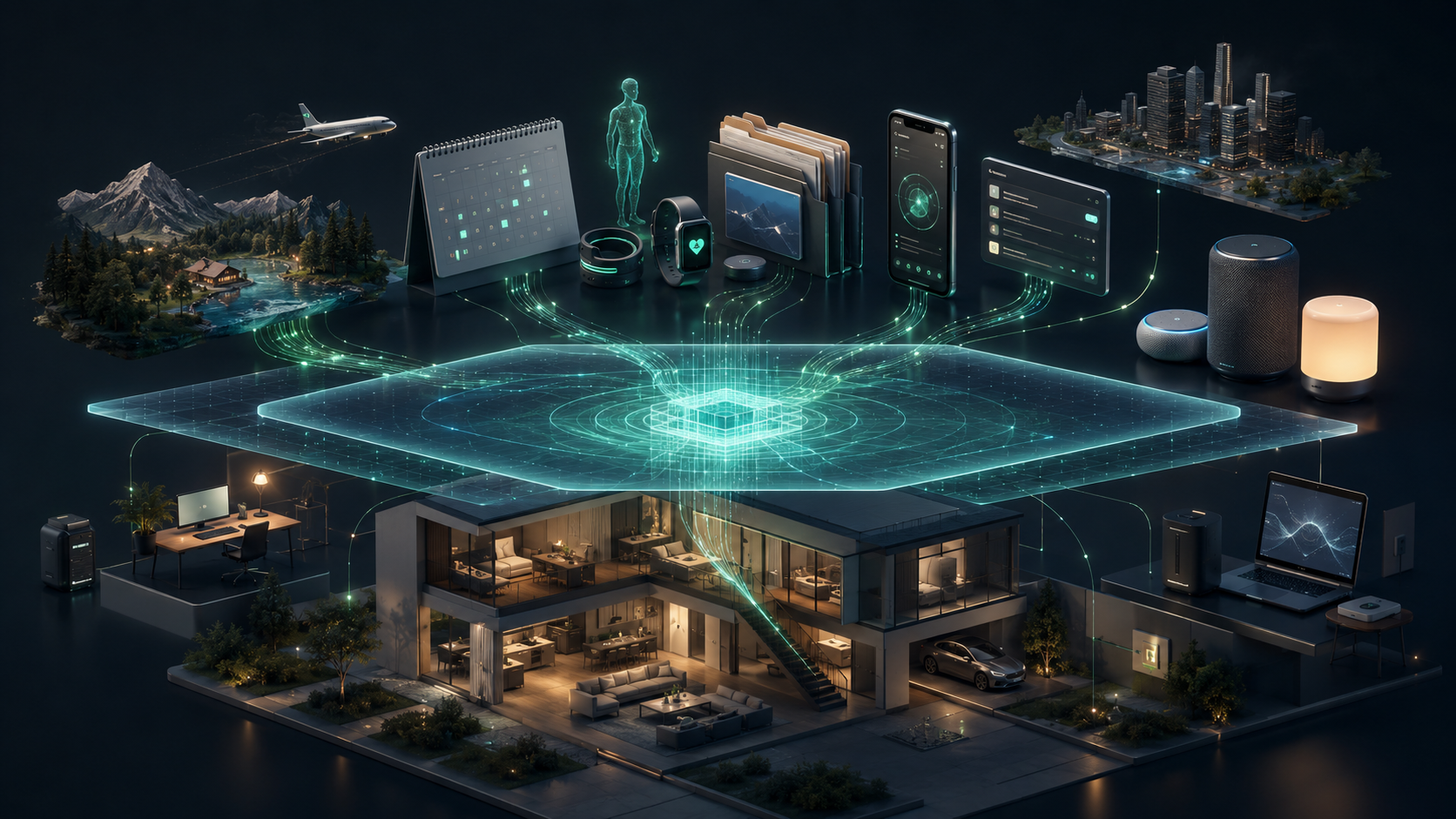
The missing layer between intent and applications
Traditional software organizes capabilities into applications. If I want to change a thermostat, update a calendar, check traffic, compare a tournament schedule, generate a document, or send a message, I am expected to know which application owns each step.
The user becomes the integration layer.
Even many AI assistants preserve this model. The chat interface is new, but the underlying interaction is still request-response. The model receives a prompt, perhaps calls a tool, returns an answer, and waits. Context is often limited to the current conversation, and responsibility ends when the response is delivered.
A personal intelligence layer changes the abstraction:
State the desired outcome. Let the system resolve the context, tools, timing, and interfaces required to achieve it.
This does not eliminate applications or APIs. It makes them implementation details beneath a shared intent layer.
In Hopper, text, voice, a web interface, an iPhone, Apple Watch, widgets, and Messages are different entrances into the same execution environment. The user should not need to understand which service owns traffic data, which machine can reach HomeKit, or which runtime is responsible for generating a report. Hopper interprets the intent and routes work across those systems.
The immediate benefit is less interface friction. The more important benefit is composability. A single request can cross boundaries that would otherwise require several applications:
- Read a changing sports schedule.
- Compare it with the family calendar.
- Update the event if the court or time has changed.
- Calculate a new leave time using current traffic.
- Notify only the people affected.
No individual application owns that entire outcome. A personal intelligence layer can.
Architecture: separate the enduring system from the model
The most important design decision in Hopper is that the model is not the application.
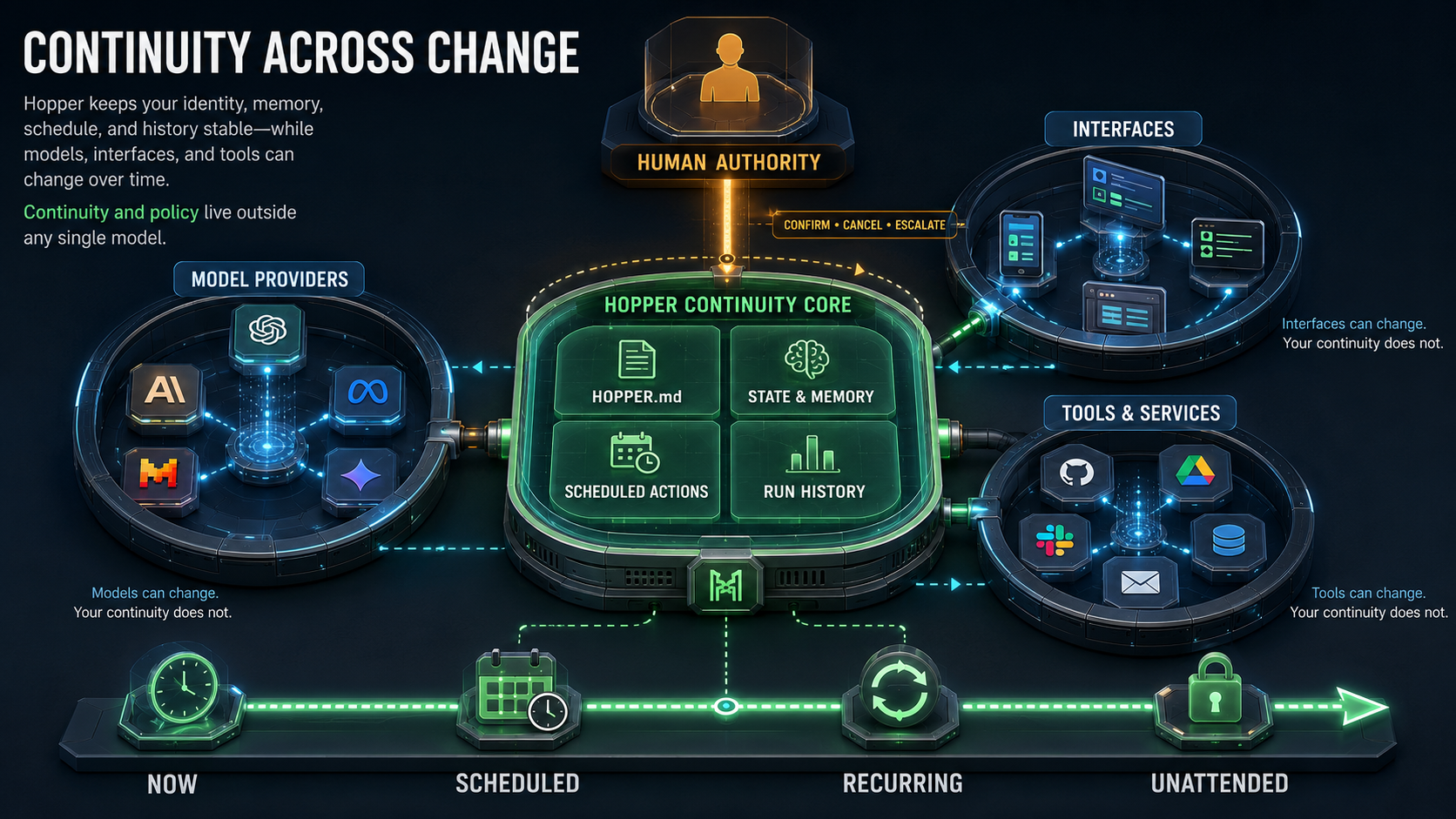
Models are cognitive engines. They interpret, plan, generate, and judge. But the identity and reliability of a personal system must live outside them. Hopper’s durable behavior is defined by its grounding, policies, tools, schedules, run history, interfaces, and relationship with the household.
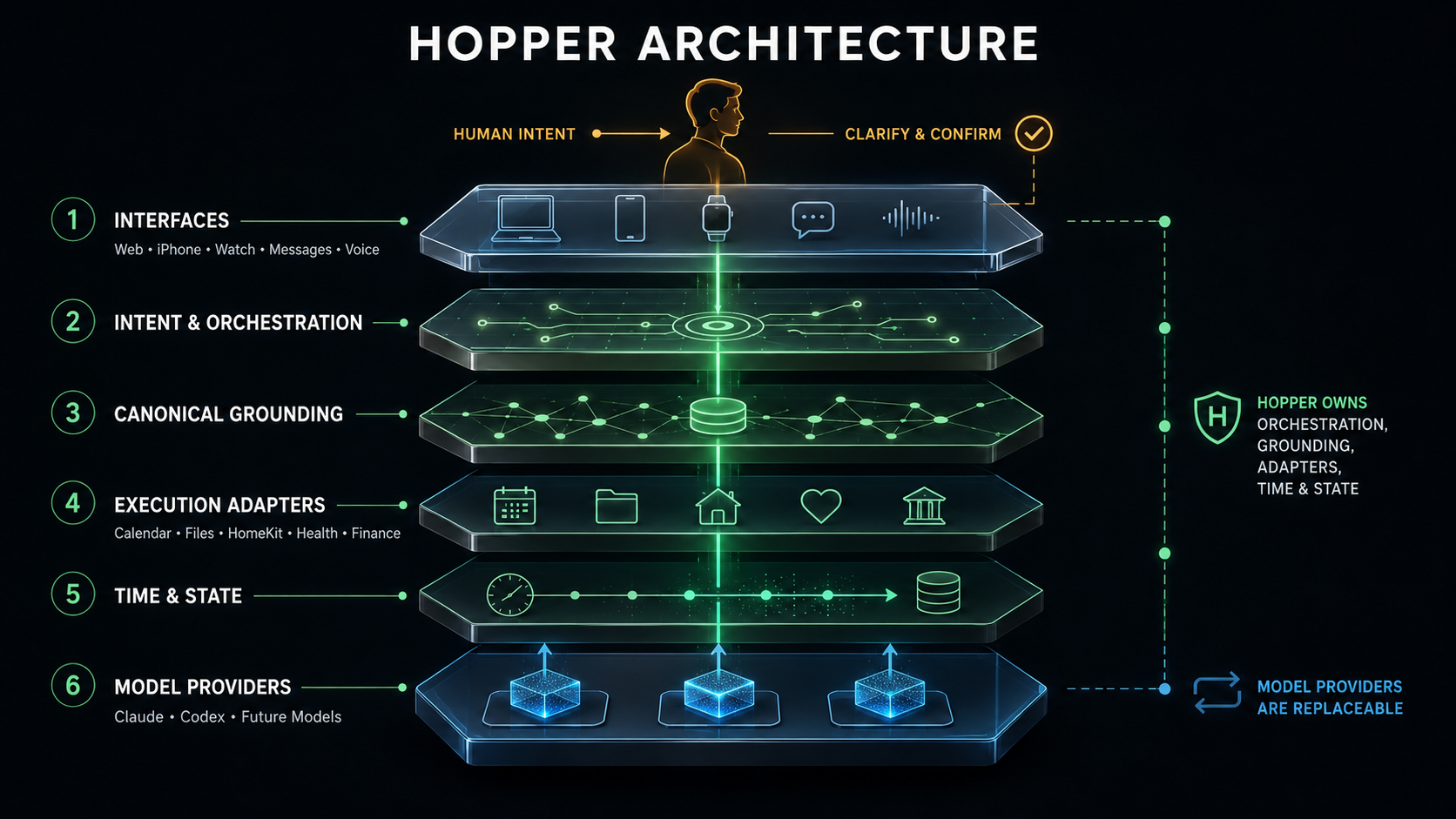
At a high level, the architecture has six layers:
- Interfaces accept intent from the web, iPhone, Apple Watch, widgets, voice, and Messages.
- Intent and orchestration normalize requests, assemble context, choose a runtime, route tools, and stream progress.
- Canonical grounding describes the household, its conventions, devices, workflows, preferences, and safety rules.
- Execution adapters expose calendars, files, messaging, HomeKit, travel, health, finance, local services, and other capabilities through consistent tool contracts.
- Time and state preserve sessions, scheduled work, run status, results, revisions, and telemetry.
- Model providers supply replaceable reasoning engines behind a provider-neutral interface.
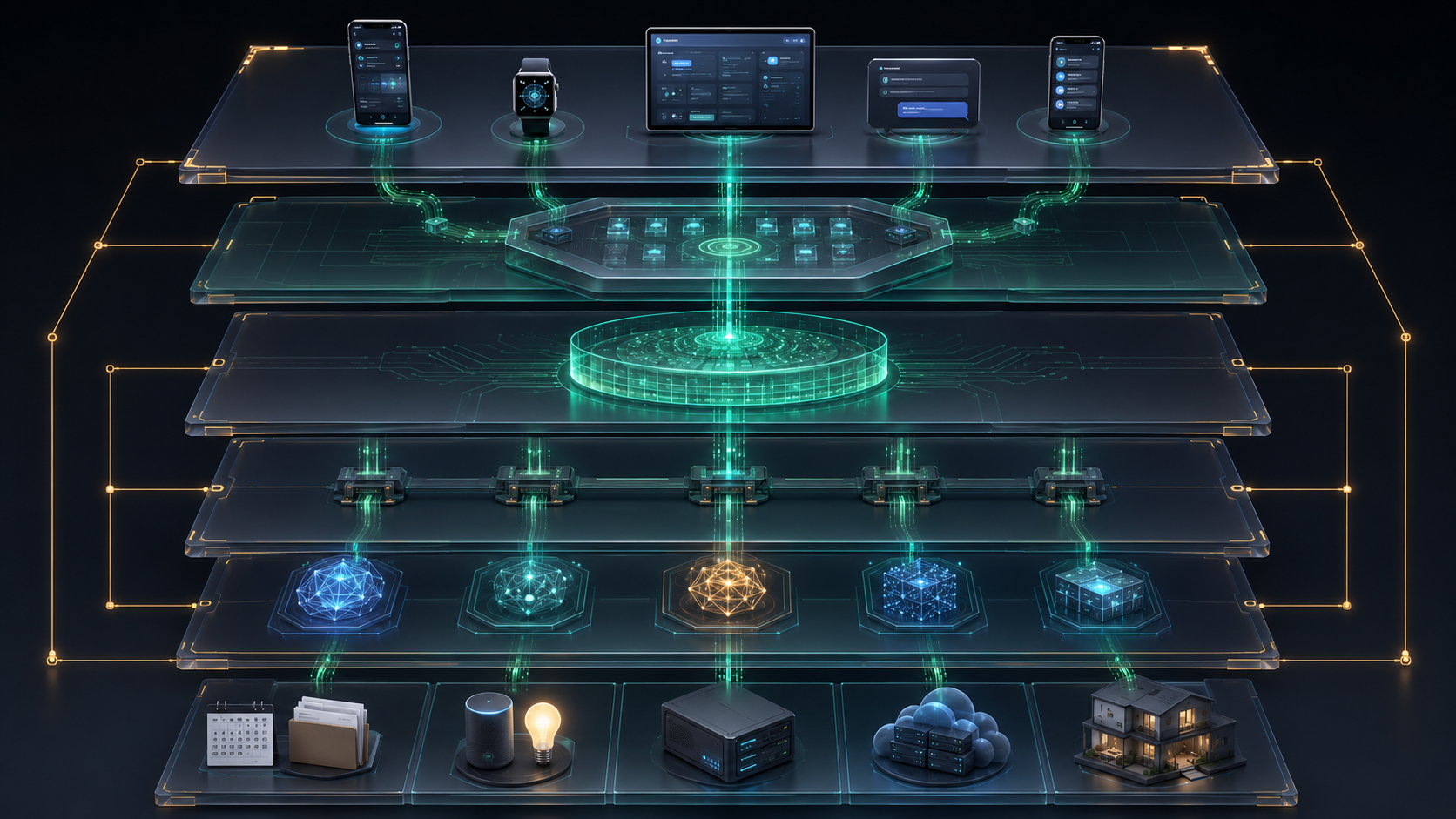
This separation creates a useful rule: anything that must survive a model change cannot live only in a prompt sent to that model.
Hopper currently applies that rule through a versioned canonical grounding document. Provider-specific instruction files are synchronized from the same source, checked for drift, and refreshed when the operating context changes. Continuing conversations can therefore receive updated grounding without pretending that a months-old session still contains the current truth.
The same principle applies to execution. Models do not connect directly to every device and API through one-off prompt logic. The surrounding runtime owns tool availability, permissions, cancellation, confirmation requirements, event streaming, and telemetry. This keeps the control plane stable even when the reasoning engine changes.
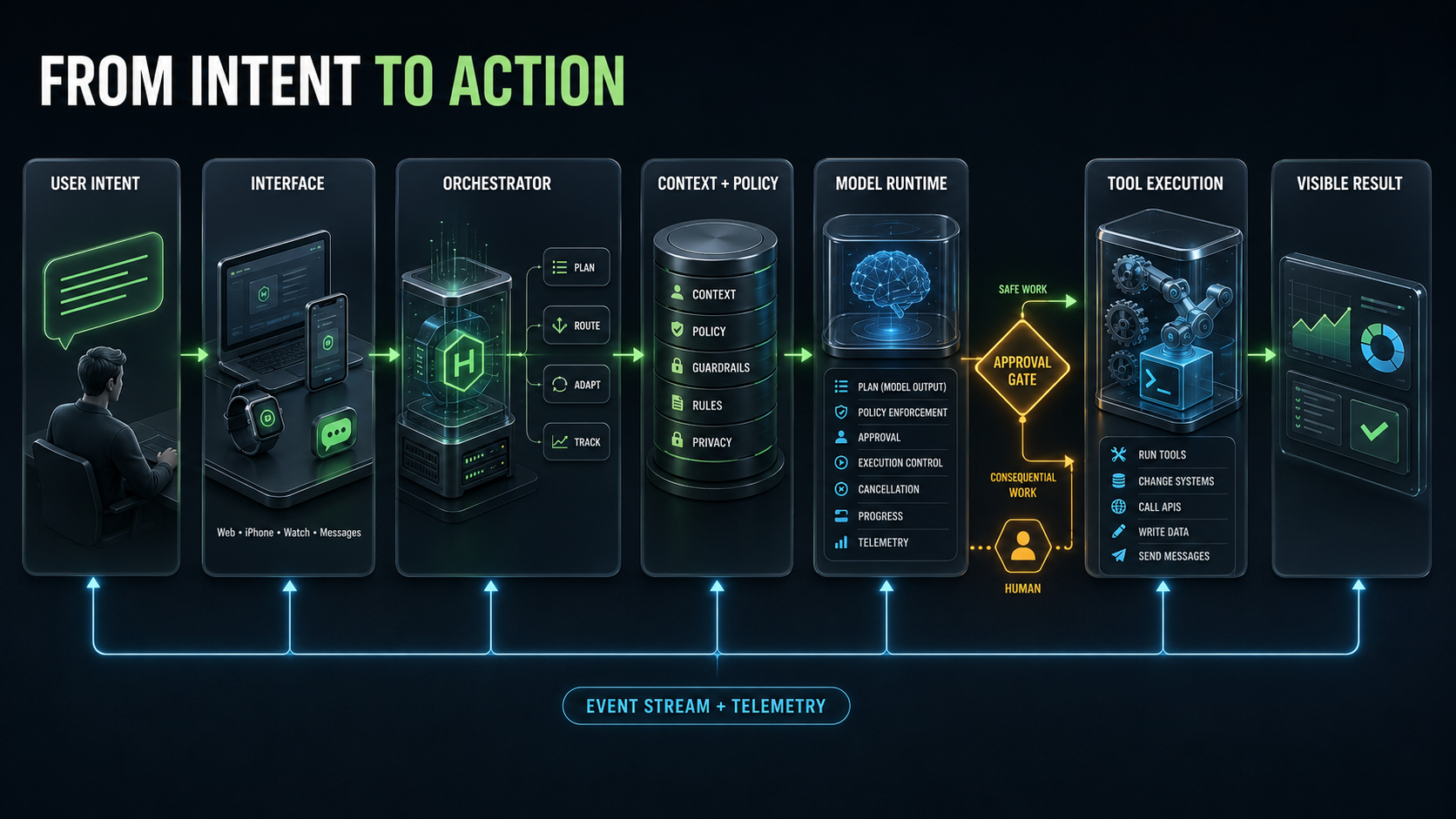
A simplified request path
A typical run looks like this:
- An interface sends the user’s intent and session identity to the Hopper service.
- Hopper loads the current canonical context and the capabilities available to that interface.
- The orchestration layer selects a model provider and begins a streamed run.
- The model produces reasoning events and tool requests through a common event model.
- Hopper checks permissions and confirmation rules before executing consequential actions.
- Tool results return to the model until the task completes, pauses, fails, or is cancelled.
- The runtime records status, timing, provider usage, tool activity, and the final result.
That final record matters. Without observable run state, “autonomy” is simply invisible activity. A personal system needs to make its work inspectable.
The current Hopper reference implementation
The current system is intentionally built from ordinary, understandable components:
- A FastAPI coordination service receives requests and exposes a consistent execution surface.
- Server-sent events carry structured progress from long-running
/runrequests to the web and native clients. - Lightweight endpoints adapt constrained surfaces such as Apple Watch and Messages without creating separate intelligence stacks.
- A persistent scheduler stores future work and checks for tasks that are ready to run. The task wakes the same orchestration environment used for an immediate request, so it can load current grounding and use live tools.
- A canonical
HOPPER.mdfile holds provider-neutral operating context. Provider-specific instruction files are derived from it, and synchronization checks catch drift before a run proceeds with conflicting guidance. - Provider adapters translate different model runtimes into a shared stream of lifecycle, content, tool, permission, completion, and failure events.
- Run history and cross-provider telemetry make latency, tool activity, failures, and model usage comparable.
- MauriceOS services expose local capabilities behind tool contracts instead of embedding device-specific logic inside model prompts.
None of these components is individually novel. The useful architecture comes from assigning them clear responsibilities. The model reasons. The orchestration service governs the run. Grounding preserves identity. Tools perform bounded operations. The scheduler provides temporal persistence. Telemetry makes the whole process observable.
Continuity is more valuable than conversational memory
The phrase AI memory often refers to facts a system remembers about a person. Useful continuity requires more than facts.
Hopper needs to preserve operational knowledge:
- Which calendar represents which family member.
- Which devices depend on a particular local machine.
- How much travel buffer to add for a basketball game.
- When a message can be sent without confirmation.
- Which home actions are safe to run unattended.
- How the family describes recurring places, teams, and routines.
- What failed previously and how the procedure was corrected.
This is closer to institutional memory than chat history.
The distinction becomes obvious when the underlying model changes. If personal intelligence is embedded only in one provider’s conversation threads, changing providers means losing the accumulated operating model. If context is maintained as a versioned system resource, different models can inherit the same understanding and constraints.
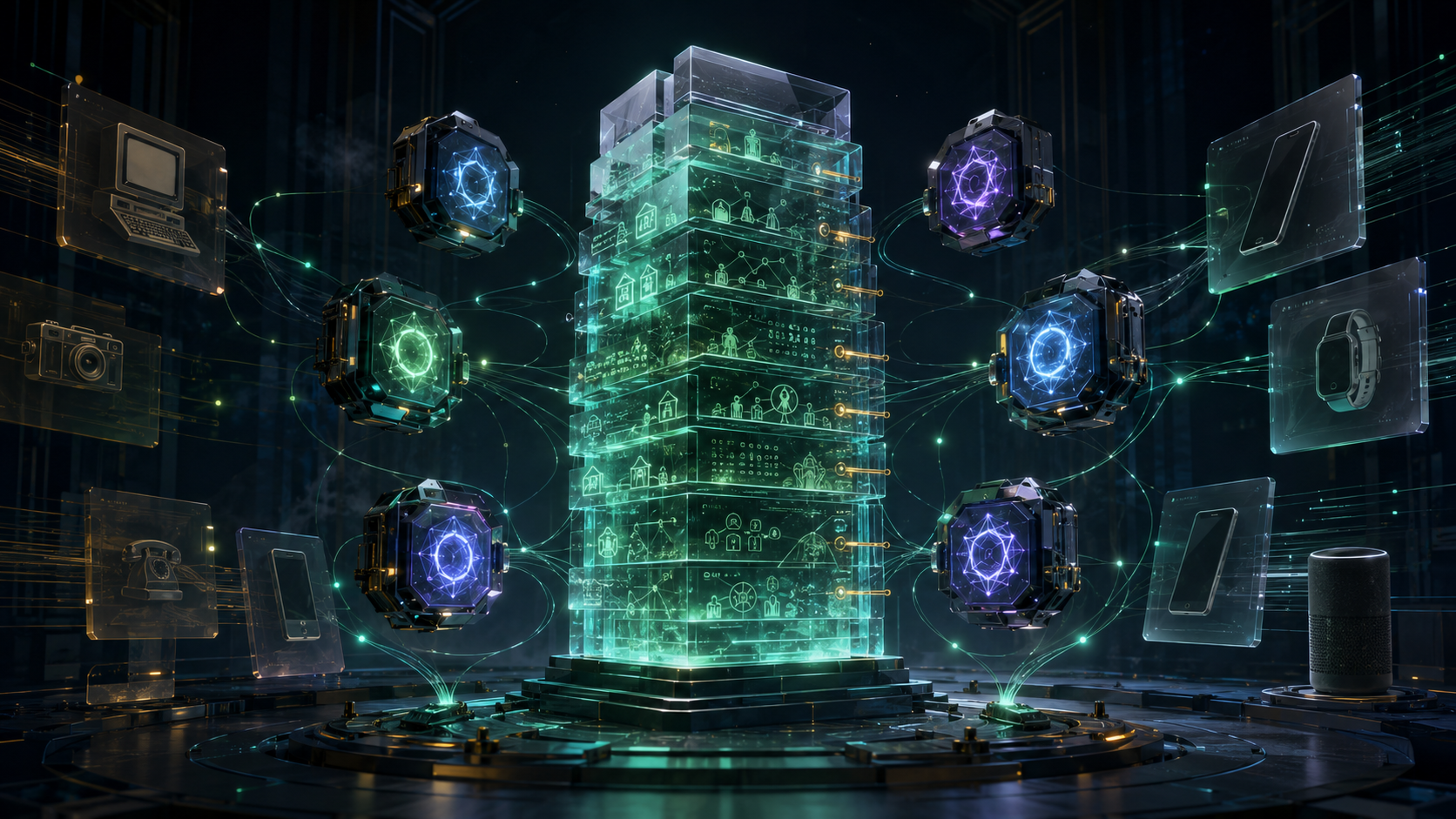
This produces what I think of as model sovereignty. Hopper can use different providers without allowing any one provider to become the permanent home of the system’s identity.
Provider neutrality is not only protection against an outage or pricing change. Different models are good at different kinds of work. A future personal intelligence layer may use one model to plan, another to research, another to critique, and a smaller local model to classify routine events. A shared grounding and event architecture allows those roles to change without fragmenting the user experience.
Time turns assistance into responsibility
Most assistant interactions are synchronous. The user asks, the model responds, and the transaction ends.
Many useful personal tasks do not fit inside that boundary:
- Check a tournament site for changes over the next three days.
- Recalculate when we need to leave if traffic gets worse.
- Prepare tomorrow morning’s household brief.
- Continue checking until an item is available.
- Update a calendar when the source schedule changes.
- Escalate only if the system cannot resolve a conflict.
Hopper’s scheduler treats these as future AI runs, not static notifications. A scheduled task can wake with fresh context, obtain current information, call tools, make a bounded decision, record what happened, and communicate only when there is something useful to say.
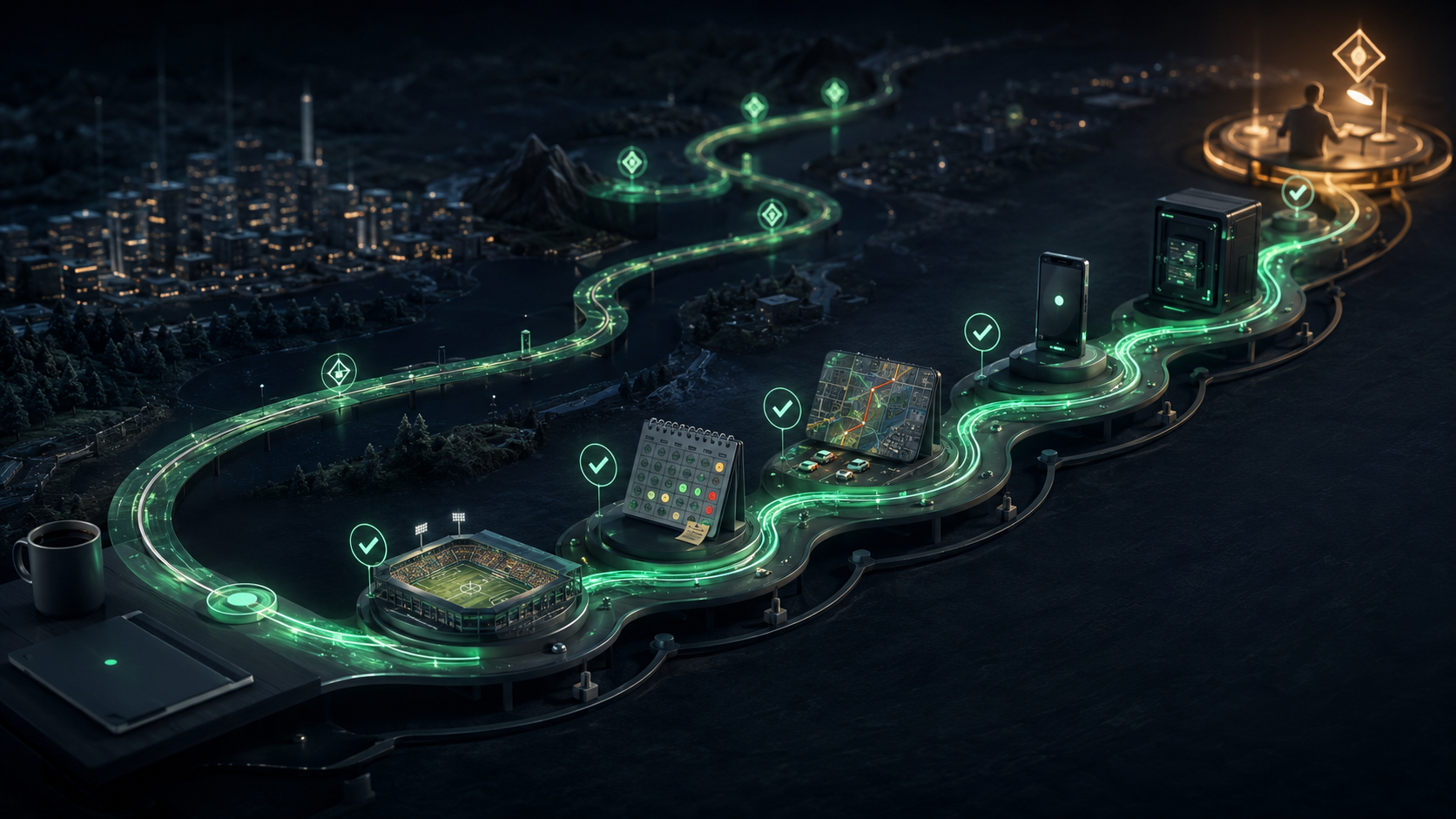
This is a subtle but important shift:
A reminder schedules a message. Delegated time intelligence schedules responsibility.
The implementation begins with a scheduler and a persistent task definition. The larger architectural requirement is a temporal control plane that can answer:
- What work is active?
- What authority does it have?
- When should it run again?
- What changed since the previous run?
- Has the goal been achieved?
- Does a human need to make a decision?
- How can the work be cancelled?
Clock-based schedules are only the first step. The same structure can support condition-based watching, event-triggered execution, bounded retries, and multi-step work that unfolds over days.
Local integration makes personal intelligence practical
Personal context is unusually fragmented. Some of it lives in cloud services, but much of it exists on local devices, private databases, home networks, calendars, files, and hardware that general AI products cannot safely or reliably reach.
Hopper uses MauriceOS as an execution fabric across that environment. A FastAPI service provides a common entry point. Server-sent events stream long-running work to clients. Local services expose capabilities such as text-to-speech, household audio, HomeKit scenes, travel calculations, and personal data workflows. Apple-device surfaces provide lightweight access without forcing every interaction through a desktop chat window.
This local-first reach creates concrete advantages:
- Lower integration friction. Existing scripts, services, devices, and databases can become tools without being rebuilt as standalone products.
- Better privacy boundaries. Sensitive data can remain local while the system shares only the minimum context required for a model to reason.
- Physical-world action. The same intent layer can coordinate software and household devices.
- Resilience. Local automations can continue to operate even when a specific cloud interface changes.
- Personal semantics. The system can understand that a nickname, gym, team, device, or routine has a household-specific meaning.
The goal is not to force every component onto one machine. It is to create a coherent control layer over a distributed environment.
Human-directed autonomy needs explicit control surfaces
There is a temptation to describe any system that acts without continuous prompting as autonomous. That word hides the most important implementation questions: autonomous to do what, for how long, with which tools, and under whose authority?
Hopper uses a more constrained model: human-directed autonomy.
The human defines the purpose, boundaries, and authority. The system determines the mechanics inside those boundaries. That requires control features to be part of the architecture, not an interface added later:
- Preview and read-only planning modes.
- Explicit confirmation for consequential actions.
- Different permissions for supervised and unattended runs.
- Cancellation and timeout handling.
- Visible progress for long-running tasks.
- Run histories and tool-level telemetry.
- Clear failure and escalation states.
- Revision history for the grounding that shaped a decision.
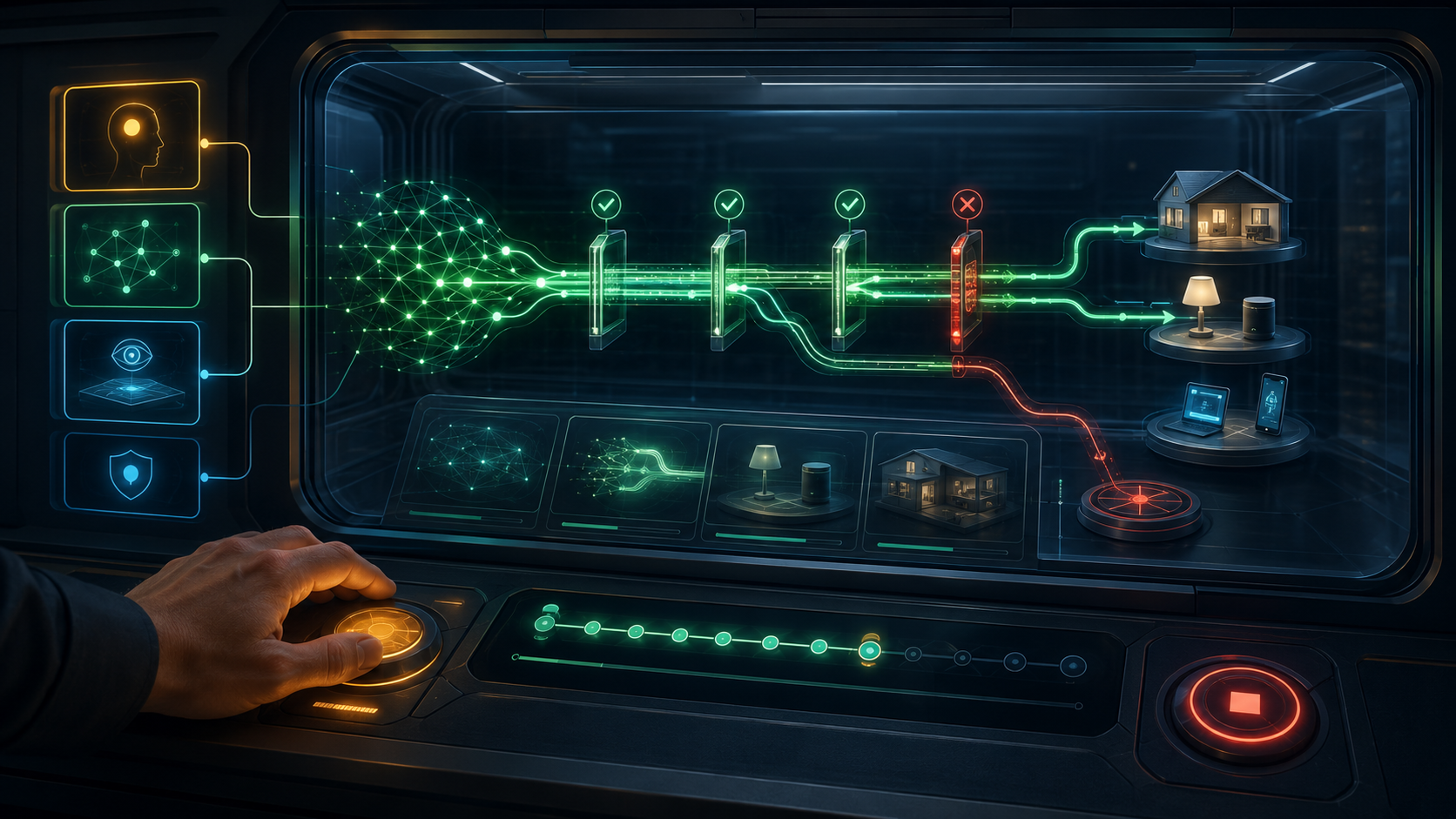
This is particularly important in a household. The correct authority for turning off a light is not necessarily the correct authority for sending a message, modifying a calendar, purchasing an item, or sharing health information.
A mature personal intelligence layer should treat authority as contextual and temporary. A scheduled watcher may have permission to read a website every hour, update one specific calendar event, and notify the family if a meaningful change occurs. It should not inherit broad permission to edit unrelated events or message arbitrary recipients.
What the architecture changes in practice
The technical layers matter because they produce a different daily experience.
One request can span domains
The user can describe an outcome without manually coordinating every application involved. The system resolves dependencies across information, devices, and services.
Context becomes infrastructure
Family conventions and operating procedures stop being repeatedly explained prompt material. They become versioned, testable inputs to the system.
Work can survive the conversation
Scheduled and condition-based runs allow the system to remain responsible after the initiating chat closes.
Models become replaceable
The personal system can adopt better reasoning engines without rebuilding its identity or losing its operating knowledge.
Automation becomes observable
Streaming events, run histories, telemetry, previews, and cancellation turn background AI work into something a person can inspect and govern.
Interfaces become interchangeable
A watch interaction, text message, web request, or spoken command can enter the same intent layer and produce consistent behavior.
The hard problems are mostly outside the model
Building Hopper has reinforced a broader lesson: model intelligence is only one part of useful personal AI.
The difficult engineering work is often in the surrounding system:
- Maintaining current context without silently overwriting history.
- Defining stable tool contracts across unreliable services.
- Distinguishing a reversible action from a consequential one.
- Recovering safely from partial execution.
- Preserving identity across providers and interfaces.
- Deciding what should remain local.
- Making future work visible and cancellable.
- Detecting meaningful change instead of generating constant noise.
- Keeping household-specific knowledge accurate over time.
These are operating-system problems more than chatbot problems. They involve state, permissions, scheduling, observability, interoperability, and lifecycle management.
A useful mental model
The simplest way to understand a personal intelligence layer is as a durable control plane for intent.
Applications still provide capabilities. Models still provide reasoning. Devices still provide sensors and actions. The intelligence layer coordinates them around a persistent understanding of one person or household.
Hopper is an early, practical implementation of that idea. It is already useful because it can connect systems that were previously isolated, preserve operating knowledge across model runtimes, and take bounded responsibility over time.
The broader opportunity is not a more personable chatbot. It is software that gradually becomes competent in the specific environment where it operates, while remaining inspectable, replaceable, and under human direction.
That is the threshold between AI that can answer and AI that can reliably participate.